
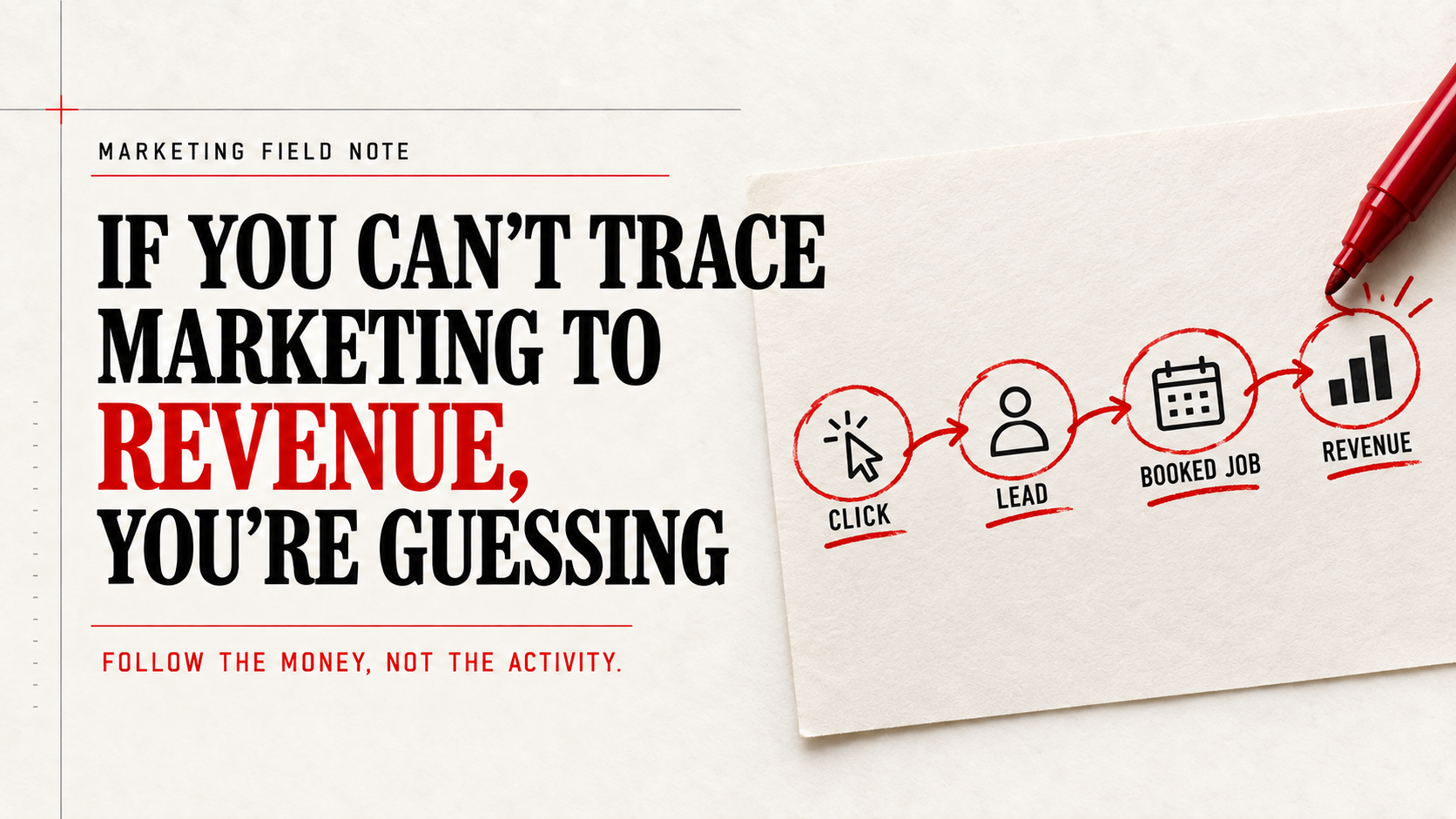
A lot of businesses can tell you what they spent and how many leads came in, but not which marketing actually produced revenue. That gap quietly bleeds money. Track the entire chain, from click to lead to booked job to dollars, so every channel gets judged on money, not clicks.
A business can spend for years, generate legitimate leads and still have no idea what actually worked. That’s not unusual. It’s actually dangerously close to the default.
The damage is bigger than one bad campaign. Without a clean connection between marketing and revenue, good channels get cut, weak channels survive and every budget conversation becomes an argument built on partial information.
“Lead” Is Where Most Reporting Quits
We audited a home-services company that had run advertising for years. The ads were doing their job. Calls came in. Clicks came in. The reporting stopped at “lead.”
There was no reliable line from lead to estimate, estimate to booked job or booked job to collected revenue. When we asked which marketing actually made money, the honest answer was simple: nobody knew.
The deeper we looked, the worse it got. Call tracking that could have connected phone inquiries to real jobs had been turned off to save a modest monthly cost. Display ads were running under the banner of “brand awareness” with no meaningful measurement. Nearly $2,000 in available marketing credits sat untouched.
Knowing how many leads came in isn’t attribution. It is a head count at the front door.
The Employee Wasn’t the Strategy
None of this is rare. It happens when marketing is treated as administrative busywork and handed to whichever employee appears to have five spare minutes.
The office manager, accountant or HR person gets voluntold to “take care of marketing” without training, authority, a measurement plan or the right systems. That is not fair to the employee, and it is not a serious way to run a business. They guess, preserve whatever was already running or avoid touching anything because nobody can explain what it does.
If you want marketing to produce revenue, somebody has to own the chain. Not the posts. Not the ad dashboard. The chain from attention to money.
Where Attribution Usually Breaks
| Reported activity | Missing connection | Business consequence |
|---|---|---|
| Clicks and form fills | Lead source to contact record | The team cannot tell which channel created the opportunity. |
| Calls and estimates | Contact to booked job | Lead volume looks healthy while close rate remains invisible. |
| Booked jobs | Job to collected revenue | Channels get judged on activity instead of actual return. |
Build the Chain
Measurement is stupid boring, unless you’re a numbers person. But, it’s crazy important and is also one of the highest-return things a business can fix. You want one clean line you can trust: click, lead, booked job, dollars.
- Track conversions that matter. Use booked calls, qualified estimates, purchases and completed applications. A form view, page visit or social like is not revenue.
- Turn on call tracking when phone calls drive the business. Use dynamic numbers where appropriate and connect qualified calls to their original source.
- Connect leads to a CRM, booking platform or job-management system. If leads live in inboxes, sticky notes and somebody’s memory, God help you. Get your head out of your stubborn bootyhole and run the business like you want it to grow.
- Carry the source through the sale. The record should show where the customer came from, whether they booked and how much revenue they produced.
- Rank channels by cost per booked customer and revenue, not cost per click. Cheap clicks that never become customers are not cheap.
- Review the chain regularly. Tracking breaks, staff skip fields and platforms change. Attribution is a system, not a one-time installation.
Once the chain is intact, the budget argument is nearly over. Move money toward what provably pays and away from what only looks busy.
What the Scorecard Should Show
- Spend by channel.
- Qualified leads by channel.
- Booked customers or completed sales by channel.
- Collected revenue by channel.
- Cost per booked customer.
- Return on marketing spend, with the assumptions clearly stated.
Key Takeaways
- Knowing your spend and lead count is not the same as knowing what made money.
- The biggest reporting gap is usually between lead and revenue.
- Phone calls, bookings and closed jobs must carry their original marketing source.
- Rank channels by cost per booked customer and revenue, not surface-level activity.
FAQ
How do I know which marketing channel actually works?
Track every channel through to booked revenue, not just leads or clicks. Compare qualified volume, cost per booked customer, collected revenue and profitability. The strongest channel is the one that creates valuable customers efficiently, not necessarily the one producing the cheapest clicks.
What is marketing attribution?
Marketing attribution connects a lead or sale back to the marketing interactions that contributed to it. For a small business, the practical goal is not a perfect academic model. It is enough reliable evidence to know what deserves more budget, what needs repair and what should be cut.
Is call tracking worth it?
If phone calls drive the business, yes. Call tracking can connect inquiries to campaigns, keywords and sources, then help the team distinguish qualified opportunities from junk calls. It closes one of the largest gaps in service-business reporting.
The Meat of It
Marketing attribution does not need to be perfect before it becomes useful. It needs to be complete enough to follow a real person from first contact to real money.
If reporting ends at clicks or leads, you are still guessing. Connect the chain. Carry the source through the sale. Judge marketing by what the business booked and collected.
If you can’t trace marketing to revenue, you do not have a performance report. You have a list of activities.
Not Sure What Is Actually Making You Money?
Vilardi Digital helps businesses repair attribution, connect marketing to real outcomes and make budget decisions with evidence instead of instinct.
Book a free call at VilardiDigital.com
About the Team
The Vilardi Digital team works across digital marketing, content, production, analytics and practical AI systems for businesses. Based in Trinity, Florida, the agency serves clients nationwide.